

Owner
10 ways to improve the interview process

10 ways you can improve your interview process!

Design a clear and concise process:Plan the stages of the interview process well in advance, including determining how many interviews will be conducted and who will be involved. Streamlining the process is key to avoid overwhelming candidates. An overly complicated process with too many interviewers or stages can cause confusion and intimidate applicants.
Prepare Thoroughly: All questions, assessments and tasks should be developed well before the interview begins. Tailoring questions to address specific challenges faced in the role is particularly important, especially if the position is niche or has been difficult to fill previously. This allows for a deeper understanding of the candidates' experiences and abilities.
Validate Claims: Instead of taking candidates' word at face value, probe deeper into their claimed experiences. Asking detailed follow-up questions helps verify their skills and ensures they truly meet your requirements. This step is essential to avoid hiring candidates who do not actually possess the skills they claim to have.
Ensure Team Coordination: Each interviewer should be well-informed about the candidates' background to ensure a smooth process. Internal communication prevents candidates from having to repeat themselves, which can be frustrating and inefficient. Ensuring that every team member is on the same page can make the interview process more coherent and professional.
Keep candidates Informed: Clearly outlining each stage of the interview process helps manage candidates' expectations. Informing them about what they need to prepare, such as presentations or tests, and giving them ample time to get ready, demonstrates respect for their time and effort.
Simplify the Process: In a candidate-driven job market, keeping the interview process as straightforward as possible helps maintain candidate interest. Prolonged processes with little feedback can lead to candidates losing interest or accepting offers from other companies. Efficiency and clarity can make your company more attractive to top talent.
Set Feedback Timelines:Informing candidates about when they can expect feedback helps manage their expectations and keeps them engaged in the process. Providing a clear timeline is a professional courtesy that can also improve the candidate experience.
Immediate Post-Interview Review: Discussing the candidate's performance promptly while the details are fresh ensures a more accurate assessment. Using a scoring system or criteria checklist can help evaluate candidates consistently across different interviewers, reducing bias and subjectivity.
Provide Constructive Feedback:Candidates often receive little to no feedback after an interview process, which can be frustrating. Offering detailed feedback, including constructive criticism for those who are not selected, can help candidates improve for future opportunities and leave a positive impression of your company.
Reflect on the Process: A well-organised interview process reflects positively on your company and can significantly influence a candidate's decision. Continuously improving your interview process based on feedback from candidates and interviewers ensures better hires and a positive candidate experience. Better interviews lead to better hires, and a well-structured process leaves candidates confident about your company.
Hardware Pioneers Max 25 Event


HARDWARE PIONEERS MAX 25
We’re Heading Back to Hardware Pioneers!
Last year, we attended the Hardware Pioneers Event in London, where we connected with incredible companies and individuals—and had a fantastic time!
We loved it so much that we’re going back this year!
If you’re attending, be sure to drop by stand A11 and say hi!
Hardware Pioneers is the UK's largest exhibition and conference dedicated to cutting-edge technologies, solutions and tools for innovation-driven engineering teams.
This is a great opportunity for us to learn more about the ever-evolving electronics industry, ensuring we stay ahead of industry trends and topics.
We look forward to seeing you there!
In the mean time, if you are looking to add new recruits into your team and would like some help, make sure to get in touch with one of our top consultants!
Sponsoring a Visa


Considering sponsoring a visa? Here's What You Need to Know!
During the recruitment process, you may encounter candidates who require sponsorship to work in the UK. While this option opens doors to a diverse pool of talent, it also comes with its own set of challenges. Let's delve into the advantages and disadvantages of sponsoring a visa.
Advantages:
- Fresh Perspectives: Visa-sponsored candidates often offer unique approaches to tasks, injecting fresh ideas into your team.
- Specialized Knowledge: Many overseas candidates bring in niche skill sets and specialized knowledge gained from diverse work experiences.
- Enhanced Diversity: Welcoming candidates from overseas fosters diversity, proven to elevate team productivity and competitiveness.
- Addressing Skills Shortages: With a persistent skills shortage in the UK, sponsoring visas increases your chances of recruiting top talent, particularly in specialized fields.
Disadvantages:
- Financial Responsibility: Sponsoring candidates can incur significant costs, including visa application fees and legal expenses.
- Time Consumption: Navigating the visa process demands extensive time commitments, from researching procedures to completing applications.
- Compliance Risks: Non-compliance with visa regulations can result in penalties for your company, highlighting the importance of thorough adherence.
- Administrative Burden: Sponsoring visas adds to your administrative workload, requiring ongoing monitoring and compliance with licensing requirements.
Conclusion:
Before deciding whether to sponsor a visa, carefully weigh these pros and cons. If you need further assistance or advice on navigating this process, don't hesitate to reach out!
Simon says, work weekends


Simon says, work weekends!
In a recent article, Simon Sinek highlights that individuals that harbour passion for their work and genuinely care about their job and company, often find themselves opting for occasional weekend work simply because they are driven by intrinsic motivation.
Simon explained that discouraging weekend work inadvertently signaled lack of appreciation for their dedication.
He speaks on enforcing a strict notion of work-life balance might not align with the prefrences of top performers; instead, showing an appreciation for their extra effort fosters a better morale and goodwill within the team.
You can read the full article by Simon Sinek here!
Time to hire!


Optimizing Your Hiring Process: Strategies to Attract and Secure Top Talent Efficiently!
In the dynamic landscape of the UK job market, where the average hiring process has extended to four weeks, timing has become a critical factor in securing top talent. With the engineering sector evolving rapidly, the need for a swift and efficient recruitment process is more pronounced than ever.
In a candidate-driven market, every moment counts. Prospective employees are often engaged with multiple companies simultaneously. A slow and inefficient hiring process can adversely impact a candidate's decision-making process and shape their perception of your company.
Recognizing that the recruitment process involves coordination across various parties and departments, effective communication becomes paramount. To expedite the process, consider the following steps:
- Prioritize Communication: Streamline the hiring journey by maintaining clear and consistent communication. Timely updates can significantly enhance the candidate experience.
- Stay Informed about the Engineering Market: Keeping abreast of the current trends in the engineering market is crucial. Understanding the challenges of candidate shortages will provide valuable insights for an effective recruitment strategy.
- Provide Timely Updates: If decisions are pending, keep candidates informed. A brief email outlining the current status ensures transparency and demonstrates respect for the candidate's time and interest.
- Simplify the Process: Excessive steps and stages in the recruitment process can lead to candidate disinterest. Streamlining the process ensures that candidates remain engaged throughout the interview stages.
- Manage Reputation: Lengthy hiring processes can harm your company's reputation and employer brand. Leveraging recruitment agencies like Enterprise Recruitment can prove instrumental in streamlining your process and maintaining a positive image.
If you have any recruitment needs, don't hesitate to reach out! We're here to help you secure the top talent effectively and enhance your hiring process.
STEM Graduate Guide

Introducing our new STEM Graduate scheme.
We know how stressful it can be to secure your first role after university, which is why we have put together our STEM Graduate Handbook!
In this handbook, you will find everything you need to help you along the way during the recruitment process, including how to write the perfect CV, what to expect at interview stage and guidance and advice on what to consider at offer stage!
You can download a copy of the STEM Graduate Handbook here!
Subscribe to our YouTube channel to watch our Graduate STEM series.
Browse our latest Graduate and Junior roles and apply directly via our website!
If you have any questions or would like additional advice, get in contact!

Introduction to ChatGPT for HR/TA professionals

An Enterprise Recruitment Webinar (Free) - Thursday 20th July 10am
Join us on Thursday 20th July, as we look into the practicality of ChatGPT for HR and TA professionals. This will be a beginners guide, inlcuding real time demonstrations on how to install, use and make the most of ChatGPT.
If you are a HR or TA professional and are intrigued by the power of AI but are not sure how to start using it, then this webinar would be a great opportunity for you to learn the basics to help get you started!
We will be demonstarting what ChatGPT can do, including 10 practical uses that you can implement into your current role right away, including topics such as writting job desrciptions, adverts and creating social media posts.
Date: Thursday 20th July 2023
Time: 10:00-11:00am
If you would like to join us, then click here to sign up for free! We look forward to seeing you there.
At Enterprise we host regular free roundtable events each quater, where we discuss the current topics! Make sure to keep an eye out on our Linkedin page for regular updates!
The engineering industry has a problem. There isn’t enough talent available.
And it’s impacting the industry in a big way. So much that 37% of engineering professionals surveyed claim the shortage has the most significant impact on their sector.
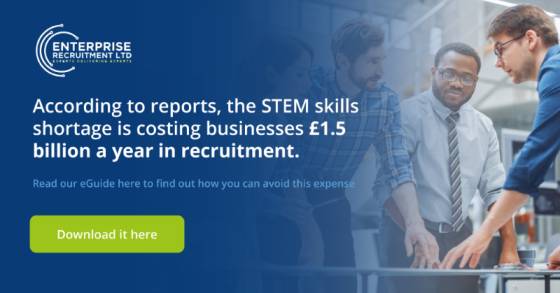
It’s impacting the industry’s pockets too. Lack of skilled labour causes delays, and “According to some estimates, the shortage of STEM skills is costing UK businesses £1.5 billion a year in recruitment, temporary staffing, inflated salaries, and additional training costs”.
Strangely, this is happening while more young people than ever are taking up STEM subjects in higher education. However, while more are studying STEM, few end up working in those fields.
In fact, only 24% of STEM graduates find a career in STEM within six months of graduation. This indicates that there’s something deeply wrong with the recruitment process.
So, what’s the solution?
We know there’s a disparity between the number of people graduating with relevant STEM degrees and the number of people who eventually become engineers. Bridging the skills gap at this level is seen as key to rebalancing the shortage. In effect, by doing so, you’re cultivating the talent pools of the future.
Here’s how you can address and overcome the problem:
Hire Graduates
Many companies take graduates on, but few have a developed scheme in place. Take note from larger companies and aim to upskill graduates into complete and qualified talent by the end of the scheme.
To attract graduates, consider your digital footprint. Many will pursue your careers page, social media, Glassdoor etc., before considering your firm. The more attractive you can make your firm online seem, the more talent will head your way.
Master the interview process
When hiring an engineer, you’ll want to know if they have the technical skills. So it can be tempting to throw out a technical test during the first stage of an interview. However, this can alienate candidates early on, and first impressions count.
Instead, Involve your A players as soon as you can in the interview process. Ideally, with the first call. They’re able to talk through the same technical sensibilities you would ordinarily test for, only far more naturally.
Review your offering
Candidates shouldn’t judge your benefits package exclusively on finances. Now more than ever, they’re interested in factors like flexible working, wellbeing initiatives, Diversity and inclusion.
Flexible working is the one benefit most candidates want, and you may begin to lose sound engineers if you neglect to offer it in some form. However, we understand that permanent remote work isn’t going to be possible for everyone joining your business. But with talent pools of skilled engineers shrinking, is it worth taking a step back and asking whether your engineers need to be in the office five days a week?
Train to retain
To keep an engineer in your firm, they need a reason to stay. They must feel engaged enough to want to remain with you for the long term. The three main drivers for retaining a highly skilled worker are as follows: “the ability to be self-directed, getting better at the job, and having a purpose in one’s endeavors”.
Are you offering that to your engineers? Because at their core, they’re cerebral creatures. The types who’d take toys apart when they were kids then put them back together. They never lost that spark. So keeping them mentally stimulated is vital for retention.
To help you understand more about the skill shortage and gain a deeper, more actionable understanding of how to overcome it, we composed a downloadable eGuide that elaborates on all these points and more in greater detail.
To download, click here to fill in a short form, and it’s yours.
We also know what makes engineers tick - speak to us at Enterprise about how to keep them engaged and add value to the business and themselves.
What’s causing the engineering talent shortage?
The engineering skills shortage is a hot topic in the sector right now. It's what everyone is talking about. And rightly so, because it's a huge problem for the industry.
We know we need to address it, but how?
To overcome the shortage, we first need to understand why it's happening. We've written this article to give you the basics of where the skill shortage started.
A good place to start would be the Shortage Occupation List (SOL). SOL highlights jobs facing a shortage of skilled labour, and the Migration Advisory Committee compiles it under the UK Government. It means special dispensations are made regarding immigration if it makes sense to bridge local skill gaps with talented migrant workers.
The idea is to encourage importing qualified talent where it doesn’t exist, effectively making it easier to recruit from international talent pools.
Engineering professionals of all classifications feature heavily on the latest version of the SOL and have done for some years now. Put simply: there aren’t enough skilled Engineers available to fill all the roles the industry has to offer, which sounds like a great problem to have. Only, the skills shortage is causing problems for businesses beyond the occasional recruitment headache.
A survey conducted by industry magazine The Engineer revealed the extent of the impact. 37% of Engineering professionals (out of 250 surveyed) identified the skills deficit as having the biggest impact on their sector.
“According to some estimates, the shortage of STEM skills is costing UK businesses £1.5 billion a year in recruitment, temporary staffing, inflated salaries and additional training costs.”
And yet, more young people than ever before are taking STEM subjects.

So, what's causing it?
Figures from the National Audit Office (NAO) show just 24% of graduates in STEM subjects are known to be working in a STEM occupation six months later. Even despite rising salaries in order to keep good people at this level.
A study conducted at Universities Leicester and Warwick attempted to work out where most STEM graduates were going in their careers, if not a technical position in the industry. According to researcher Dr Patrick White: “STEM graduates were more likely to work in teaching and management than in key ‘shortage areas’ such as science, engineering and ICT.”
The same study revealed there was “no evidence of older workers moving into STEM careers later in life” either. So there’s a lack of qualified talent entering and remaining in the industry, to begin with, but this isn’t the only factor.
Covid-19 has been the defining factor for all industries. While the world now expects to work remotely, it’s very rare an engineer is able to. This immediately limits your access to talent.
To overcome it you'll need to...
There are a few things you can do in order to tackle the shortage:
-
Hire Graduates
-
Get Your Interview Process Right
-
Review Your Offering
-
Train to retain
We've recently composed a downloadable eGuide that elaborates on all of these points in more detail. If you'd like to download it, click here to fill in a short form and it's yours to keep.
We also know what makes engineers tick - speak to us at Enterprise Recruitment about how to keep them engaged at the same time as adding value to the business and themselves.